You may only know Joseph (John) Merrick because of the physical deformities that earned him the label of “The Elephant Man.” He was, as is anyone tagged with a label of any kind, much more than that label. We at the Commonweal are thrilled to mount the later life story of Joseph Merrick and introduce you to the remarkable man that he was.
- By all accounts, was completely healthy and normal at birth. The deformities began to develop at age 5.
- Despite his appearance, he attended his local school.
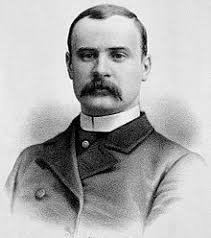
Frederick Treves
- He spent most of his time conversing with his doctor and friend, Frederick Treves or writing poetry and prose.
- He built a cardboard model of St. Philip’s Church.
- Baffled by doctors and scientists when he was alive, it is now considered that Merrick suffered a rare case of neurofibromatosis or a disease known as Proteus Syndrome.
- His parents attributed his disorder to his mother having been kicked and knocked to the ground by an elephant while at a fairground.
- His head circumference was measured at 36 inches, his right hand at 12 inches and one of his fingers at 5 inches.
- His life was saved by a business card that he kept in his possession for two years.
- A replica of his skeleton is on display at Royal London Hospital. The actual skeleton is in the medical college of the hospital but not on permanent display.
- He had three siblings who died remarkably young. Brother William Arthur died of scarlet fever at age four. His sister, Marion Eliza, passed at age 24 from Myelitis related seizures.
- At age 13, Joseph was a door-to-door salesman selling items out of his father’s barbershop. He wore a burlap sack to cover his deformities.
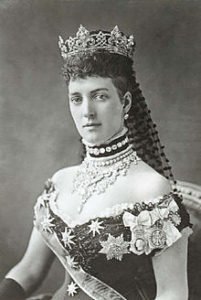
Princess Alexandra of Denmark
- In his four years of living at the London Hospital, he was visited and befriended by the highest levels of British Society right up to Her Royal Highness Princess Alexandra who held the title of Princess of Wales from 1863-1901, the longest anyone has ever held the title.
- He was highly intelligent and wrote many letters, mostly of thanks for much patronage while he lived in the London Hospital. Those letters were always signed off with the following poem:
‘Tis true my form is something odd,
But blaming me is blaming God;
Could I create myself anew
I would not fail in pleasing you.
If I could reach from pole to pole
Or grasp the ocean with a span,
I would be measured by the soul;
The mind’s the standard of the man.
- He died on April 11, 1890, at the age of 27.
The Elephant Man begins previews Friday, May 19 and the gala opening performance is Saturday, May 27.
 Twenty years ago, a pledge was made. A pledge to a playwright and his works. A pledge to an audience base. A pledge to a company of artists that, for the foreseeable future, the works of that one playwright would be produced on an annual basis. Countless other things have come and gone but that pledge remained strong.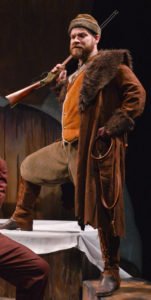
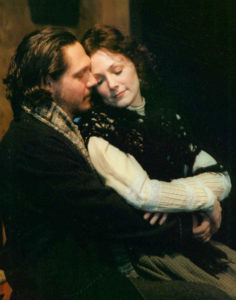

 This script, this story and this person stirred something in me; something I hadn’t felt with the other plays. Not only did I immediately connect to the story, but I felt that people needed to hear this story right now. Here. This specific moment. Today. You. Us. Them. In this world. In our town. In the surrounding towns. THIS is the story I wanted to tell. That’s pretty much when my decision was made. I am happy to say, with confidence, that it was the right one.
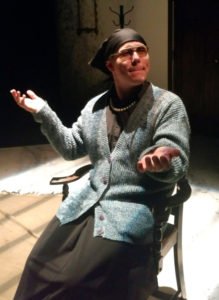 That way, the person doesn’t become completely lost in the interpretation, but the actor also gets the freedom to craft them into something unique; into something they want them to be. Doing this 35 times seemed impossible, especially with the timeline we were working with. Lucky for me, I had Amanda Pyfferoen (dramaturg/stage manager) and Philip Muehe (director) in the rehearsal room with me. Whenever I had a specific historical question or came to a creative road block, they were right there with the knowledge and spark of creativity that the situation needed.